Sand in the Coffee, Vol. 95: the water behind the beach, and why it never gets a flag
Got a message this week from a renter that I’d like to answer in public, because I get some version of it every September: “What color is the flag on the back side of the island? I can’t find one.”
There isn’t one. That’s the whole column.
What’s actually back there
Stand on Perdido Key Drive and look north instead of south. Behind the condos is Old River, the strip of water that runs between the Key and Ono Island. Follow it east and it opens into Big Lagoon, which is what the whole north side of the east end of the Key sits on. Follow it west and you hit the state line, the Flora-Bama’s dock side, and then the Orange Beach back bays: Bayou St. John, Terry Cove, Cotton Bayou, and Wolf Bay, all of them stitched together and all of them draining out to the Gulf through one cut under the bridge. That cut is Perdido Pass. Locals just call it the Pass.
The Gulf side is the postcard. The back side is where the boats live, where the mullet jump, where the dolphins push bait up against the docks at first light, and where, on a September weekday, you can float in warm flat water for an hour and see six people.
Why there’s no flag
The beach flags exist for one reason: surf. Rip currents, shore break, the trough between the sand and the bar. Green, yellow, and red are a report on the waves. Purple is a report on what’s in them. Check the Gulf side here before you cross the road, because that side is trying to tell you something.
The back side has no waves, so it has no flag. But here is the sentence I want you to carry down to the water: no flag is not a green flag. The back side isn’t trying to hurt you. It’s also not trying to save you. There’s no lifeguard and no color on a pole. What it has instead is a different set of hazards, and every one of them is easy to handle once you know it’s there.
The five rules of the quiet side
One. Stay out of the channel. The Intracoastal runs through Old River, and every bay behind it has a marked channel, red posts and green posts. Between the posts is a highway. Barges use it. Boats coming in from a day offshore use it, fast, with a captain who has been in the sun since five. Swim, float, and paddle along the edges, close to the shore or the docks, and treat the marked water like a road you’d look both ways on.
Two. The Pass is not a swimming hole. It’s a hallway with a current. On an outgoing tide the whole back-bay system is emptying into the Gulf through that one cut, and it will move you faster than you can swim. Same goes for the water within a few hundred yards of it on either side, which pulls harder than it looks. Enjoy the Pass from the jetty, from a boat, or from a restaurant deck. Not from the water.
Three. Face the wake. A boat wake on Old River is small until it reaches you, and then it’s exactly tall enough to fill your cooler and find your sandwich. If you’re on a paddleboard or in the water when a boat goes by, turn to meet it. Sideways is how people get wet with their phone in their hand.
Four. Wear something on your feet. The Gulf side is sugar sand. The back side is sand with oyster shell in it, and oyster shell is nature’s way of testing whether you actually needed that toe. Old water shoes or sandals with a strap. Not flip-flops. Flip-flops in a lagoon are a donation.
Five. Jellyfish don’t read flags either. September has plenty of them on both sides. On the back side they drift in slow with the tide, and you’ll usually see them before they see you. If the water looks like it has a few moons floating in it, it does. Give them the lane.
When to go
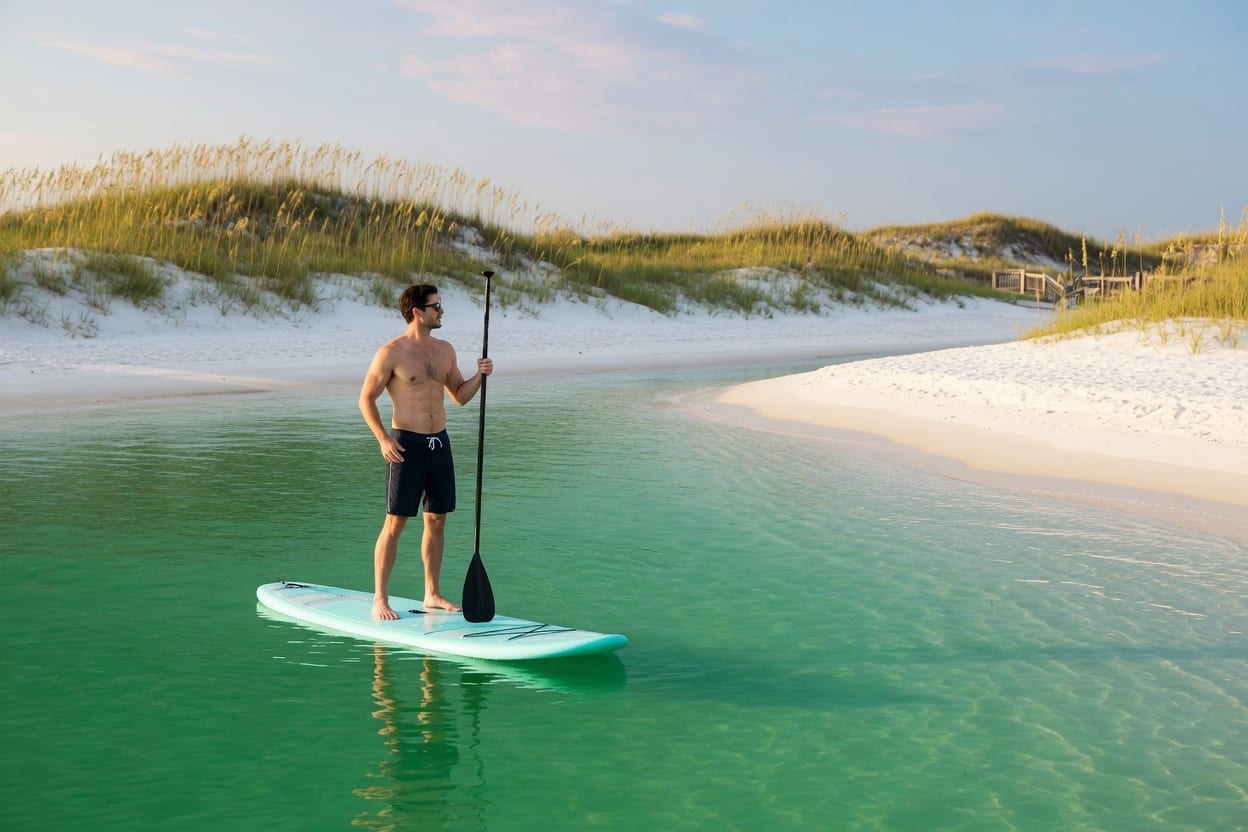
Mornings, first. Before the sea breeze builds, the back side goes slick calm, which is local for water you could set a coffee cup on. That’s paddleboard water. Dolphins work Old River early, and you’ll hear the mullet before you see them.
Afternoons, second, and this is the real trick. When the southwest wind gets up around two and the Gulf turns to chop, the back side stays flat. The condos and the island itself block the wind. So the day plan that works all September is: Gulf at seven, breakfast, back side at three, and dinner on a dock. Two short trips, two different bodies of water, one parking spot each.
Weekdays if you can. Weekend afternoons the back bays fill with boats, and just inside the Pass on the Orange Beach side there’s a pair of small islands, Bird Island and Robinson Island, where the boats raft up hull to hull and the music competes. It’s a good time. It’s also not quiet, and it’s not where I’d send you with a paddleboard and a six-year-old.
How to get on it without a boat
You do not need a boat. You need to know where the public edges are.
Big Lagoon State Park, Florida side. A few dollars a car. The lagoon beach is shallow, warm, and calm, with pines for shade and a boardwalk out over the grass flats. This is the first place I’d put anyone with little kids, or anyone who has decided that shore break is a young person’s game.
Johnson Beach, the National Seashore at the west end of the Key. Everybody knows the Gulf side. Fewer people know the road runs with Big Lagoon on your right, and there are pull-offs along the lagoon where you can wade in without a wave in sight. Same entry fee covers both sides. Take the lagoon side at sunset. The light goes down the water instead of over it.
Orange Beach Waterfront Park, on Canal Road on the Alabama side. Free. It sits on Wolf Bay with a fishing pier and a playground, and it is the easiest way for a family staying in Orange Beach to put their feet in back-bay water without renting anything.
Rent a paddleboard or a kayak. Outfitters on both sides of the line rent by the hour and will point you at the right cove for the wind that day. Ask them. They’d rather tell you than come get you. If you want to know what’s swimming under you while you’re out there, the fishing page covers what’s biting in the bays this time of year. The redfish are back there for the same reason you are.
The dock-side restaurants. The Old River side of the Key and the Cotton Bayou side of Orange Beach are lined with places that put you on a deck over the water. You get the boat parade, the pelicans, and the sunset without getting your hair wet. The happy hours on both sides of the state line run through the exact hours the back side looks best.
The short version
The Gulf has a flag because it has waves. The back side has no flag because it has none, and that’s the part that fools people. Read the channel markers like street signs, keep away from the Pass, face the wakes, wear shoes, and go in the morning or the late afternoon. Do that and you’ll have the calmest, warmest water on the island mostly to yourself, one road north of where everybody else is fighting for a spot.
The flag is for the front. The back side runs on judgment. Bring some.
— Chris
P.S. If you run a place on the Key or in Orange Beach and it’s on this site, it’s yours to claim — free, always: /submit/claim/